top of page
Kagawa Lab.
Marine Evolutionary Ecology and Conservation
Marine ecosystems exhibit high biodiversity. How did this diversity originate, and how has it been maintained until today? Although numerous theories in evolutionary ecology have been proposed, many aspects of these processes remain unresolved. In our laboratory, we aim to address these fundamental questions in biodiversity science by integrating a variety of approaches, including fieldwork, ecological experiments, statistical modeling, and population and phylogenomic analyses.
Keywords
Marine biology, biodiversity, evolutionary biology, ecology, conservation biology, behavioral ecology, speciation, symbiotic organisms, molluscs, intertidal zone, coastal ecosystems, biogeography, population genetics
Organisms studied (including collaborative research)
Molluscs (terrestrial, freshwater, and marine), green algae, arthropods, flatworms, corals, birds, and reptiles
Research topics
How do species interactions promote biodiversity?
Various species interactions, such as competition, predation, and symbiosis, are ubiquitous in ecosystems. The ecological and evolutionary roles of these species interactions have long attracted attention and remain an important topic in evolutionary ecology. In our laboratory, we aim to elucidate the nature of species interactions by combining ecological experiments under controlled conditions and DNA barcoding etc. Furthermore, we are investigating how traits involved in species interactions have influenced speciation and phylogenetic diversification using phylogenomic and population genomic approaches.

How does the physical environment shape biodiversity?
The intertidal snail L. correensis and the green alga P. conchopheria, which grows on its shell. The wet alga reduces thermal stress in the hosts.
How do environmental heterogeneity and site-specific histories of environmental change shape the structure and dynamics of populations and communities? In marine ecosystems, the fluidity of water masses creates unique ecological conditions that are fundamentally different from those of terrestrial ecosystems. Moreover, these physical environments have undergone repeated changes throughout history. In our laboratory, we aim to elucidate the influence of physical environments on the structure and dynamics of marine populations and communities by using approaches such as population genomics and ecological niche modeling.
Data Collection and Utilization for Biodiversity Conservation
The collection of fundamental data is essential for biodiversity conservation. For example, taxonomy, which examines whether a given organism differs from previously reported species, forms the foundation for understanding biodiversity. In addition, the accumulation of distribution records of individual species is becoming increasingly important, not only for characterizing species but also for assessing the impacts of recent environmental changes. We are working to accumulate fundamental data relevant to biodiversity conservation and to explore effective strategies for biodiversity conservation based on such data.
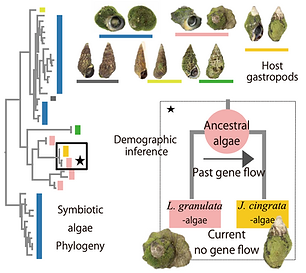
Genetic analyses revealed that the algae underwent speciation through host shifts, even under the presence of gene flow.
Access
Department of Marine Biology, School of Marine Science and Technology, Tokai University
bottom of page